Transgender Comprehensive Lethal Evidence Analysis Report
Case-level analysis of every documented transgender homicide in the United States, 2015–2024. All data independently verified through court records and local news coverage.
The Human Rights Campaign has published annual reports documenting transgender people killed in America since 2015. Their data is the foundation of this study. But HRC never reported who was actually committing the killings, and nearly every institution that cited their data attributed the violence to White supremacy and societal transphobia. HRC itself attributed the deaths of “our Black trans siblings” to “an epidemic of violence” fueled by “systems of white supremacy” in June 2020, the same year this study found zero White suspects identified. This study took HRC’s victim lists and did what HRC never did: independently verified every case from 2015 to 2024 against court records, news coverage, and police statements to identify the perpetrators (N = 304 victims; 186 identified suspects). The findings are the categorical opposite of the narrative.
PRINCIPAL FINDINGS
This study analyzed all 304 cases of fatal violence against transgender individuals documented by the Human Rights Campaign from 2015 to 2024 and produced the following findings:
- Black suspects account for 65.1% of identified perpetrators (123 of 189), nearly five times the Black population share of 13.6%. White suspects account for 18.0% (34 of 189), less than one-third their 59.3% population share.
- This racial distribution is consistent with general homicide patterns, not unique anti-transgender bias. A contextual model incorporating FBI intraracial homicide rates predicts a 67.6% Black suspect rate; the observed 65.1% falls below this prediction.
- Approximately 80% of cases are intraracial, mirroring FBI single-victim/single-offender homicide data. Transgender homicide follows the same racial dynamics as American homicide generally.
- Only 3.3% of cases resulted in confirmed hate crime determinations. Even under a liberal sensitivity analysis assuming Unknown-motive cases contain double the bias rate of known cases, the figure reaches only 11.6%.
- The primary identified motive is intimate partner violence, not bias. The institutional framing of anti-transgender violence as driven by societal transphobia and White supremacy is not supported by case-level evidence.
- Solve rates average 61%, at or above national benchmarks. Case files document at least 120 convictions and guilty pleas. 91% of Black homicide victims nationally are killed by Black offenders (FBI). This is not arrest bias. It is intraracial homicide.
- In 2020, zero White suspects were identified, the same year institutional rhetoric most aggressively attributed anti-transgender violence to White supremacy.
- Young Black transgender women (biological males) comprise 69% of all victims, yet their homicide rate is approximately one quarter that of young Black non-transgender men. Dinno (2017) compared these biological male victims to non-transgender women, producing an alarming 2.3× multiplier. But the biologically appropriate comparison is non-transgender men: 367 per 100,000 vs. 95.1. The “epidemic” was built on comparing biological males to biological females. The male rate appears in the same published paper (see Discussion for full analysis and verification note).
- The aggregate transgender homicide rate remains below the general population rate, though this aggregate is driven down by the majority who face very low risk. The term “epidemic” obscures where the danger actually is: young Black transgender women, killed by people they knew, in circumstances that look nothing like a hate crime.
- The violence is biological males killing biological males. 90% of suspects are male; 92% of victims are biological males. Combined with the intraracial finding (~80% same-race), the complete picture is Black biological males killing Black biological males in intimate relationships and sexual encounters. Every dimension matches the baseline of American homicide.
Since 2013, the Human Rights Campaign Foundation has published annual reports titled “An Epidemic of Violence,” documenting fatal violence against transgender people in the United States. These reports became the authoritative source behind presidential proclamations, congressional resolutions, AMA declarations, and celebrity open letters, all framing the violence as a product of societal transphobia, legislative hostility, and systemic racism. But HRC’s reports never examined the data at the case level. They do not report suspect demographics, code motive evidence, compare outcomes to national benchmarks, or test whether the patterns differ from general homicide dynamics. No other study has done so either. The entire institutional consensus was built on data that no one independently analyzed.
This study used HRC’s own victim lists as its source framework, then independently verified all 304 cases from 2015 to 2024 against court records, local news coverage, police statements, and autopsy reports. For each case, suspect demographics were identified, bias motivation was coded against a four-tier framework, circumstances were categorized, and case outcomes were tracked. The results are presented below.
Population figures: U.S. Census Bureau, American Community Survey (ACS), 2020–2023 estimates. Black alone non-Hispanic: 13.6%; White alone non-Hispanic: 59.3%; Hispanic or Latino: 19.1%; Asian and all other: 8.0%. Suspect data: independently verified, 2015–2024 (N = 189).
Key Finding: Only 10 of 301 coded cases (3.3%) resulted in confirmed bias determinations. The majority were Unknown (55%, driven by unsolved cases) or No Evidence (28%). This does not mean bias was absent, but it challenges the framing that most of these homicides are hate crimes.
Note: 163 of 304 cases (54%) had unknown or unclear motives, mostly unsolved. The true motive distribution may differ.
The HRC Foundation report Black LGBTQ People and Compounding Discrimination (June 2021, page 2) specifically names four Black transgender women killed in January 2021 as evidence that White supremacy is driving the violence, citing “an epidemic of violence fueled by discrimination and bias.” This study independently verified every one of those cases through local news and court records. Here is what the evidence shows:


HRC published their report in June 2021. By that date, Brooks and McLaurin had already been arrested. The case facts were public record. HRC’s own memorial page for Fifty Bandz acknowledges she “was killed by someone she knew.” They knew who killed these women. They blamed White supremacy anyway.

On a building at 2013 Neighbors Alley in Midtown Sacramento, a public mural memorializes Chyna Gibson, a Black transgender performer shot ten times in a New Orleans parking lot in 2017. The right panel reads “Protect Our Trans Daughters.” The left reads “White Silence = Violence.” NOPD identified two Black men as persons of interest (not suspects, persons of interest) and explicitly stated there was “nothing demonstrating that this is a hate crime.” No white person has ever been connected to her death. In this dataset, Black suspects account for 123 of 189 identified perpetrators: 65.1%, nearly five times the Black share of the U.S. population. The mural does not name a suspect, mention intimate partner violence, or acknowledge any of this. It skips the data and proceeds directly to the narrative.
Consider the reverse. If white men were killing Black transgender women at over four times their population share and a mural appeared reading “Black Silence = Violence,” the building would not survive the week. The phrase would be catalogued as a hate crime. The artists would be investigated. The city would issue a public apology. Every institution cited in this study would mobilize against it. But when the actual perpetrators are disproportionately Black and the mural blames white people, no one objects. Not because no one knows, but because knowing would require confronting uncomfortable truths that no one in American public life is permitted to say out loud. Consider the world this creates: stating the opposite of the truth is considered brave, and it gets put on a wall. Stating the actual truth would get that same wall burned down and the person who said it investigated. That is the world you are living in.
The mural can be viewed on Google Street View at 2013 Neighbors Alley, Sacramento, California (image dated February 2025).

Malik Jackson was 21 years old. He worked at Five Guys in Tallahassee. His boss said he would arrive before the restaurant opened, sitting in the parking lot waiting for someone to unlock the door. He loved to fish. He loved to dance. His aunt described him simply: “Malik was a good kid. Malik didn’t get in any trouble. Malik smiled a lot.”

Tony McDade was a 38-year-old Black transgender man (biological female) released from a ten-year federal prison sentence for armed robbery four months earlier. He entered a relationship with Malik’s mother, Jennifer Jackson. According to the Jackson family and police records, McDade pistol-whipped Jennifer in her home and sent threatening texts including “I’ll kill for you and you.” Malik told McDade to leave and stop disrespecting his mother. On the morning of May 27, 2020, McDade posted a Facebook Live video threatening to kill five people. Shortly after, he walked to Jennifer’s home, where Malik was sitting in his car before work, and stabbed him in the neck. Malik died at the hospital. COVID-19 restrictions prevented his mother from entering the building, even as she begged to see him. McDade fled, pulled a gun on responding officers, and was shot and killed. A grand jury ruled the use of force justified.
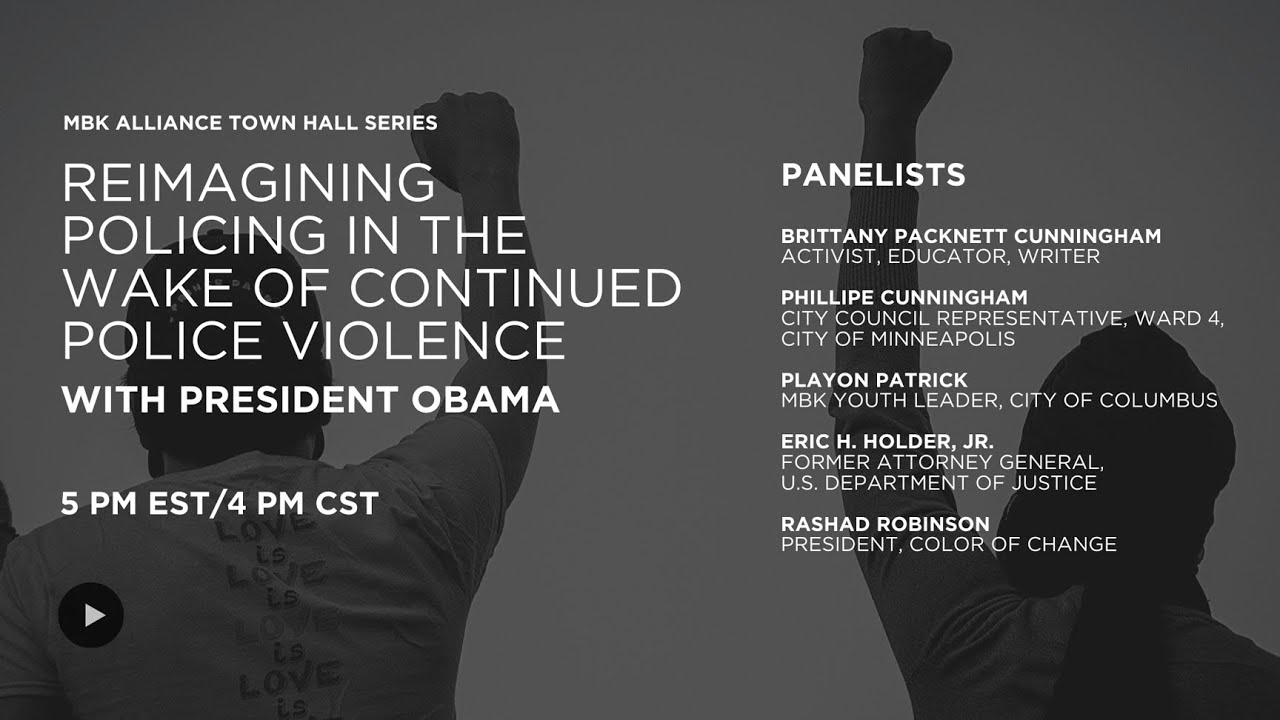
Obama Foundation Town Hall, June 3, 2020 | “Reimagining Policing in the Wake of Continued Police Violence”
One week later, former President Barack Obama hosted an Obama Foundation town hall titled “Reimagining Policing in the Wake of Continued Police Violence.” He named Tony McDade alongside George Floyd, Breonna Taylor, and Ahmaud Arbery as victims whose memory demanded a reimagining of American policing (verified by The Advocate). The remarks strongly suggest no one at the Obama Foundation verified the facts of the case. No one mentioned Malik Jackson. His mother, who was not allowed to hold her dying son’s hand, watched a former president memorialize the man who killed him. The Jackson family’s attorneys responded publicly: “We believe that if President Obama knew exactly what happened on May 26th and May 27th, he would not have made those statements. And we believe an apology should be stated to the family of Malik Jackson.” No apology was ever issued.
When a local activist was asked whether McDade’s actions should factor into the public response, she answered: “It doesn’t matter what he did.” Malik Jackson’s aunt offered a different view: “Malik Jackson’s life mattered too.”
Malik Jackson is not in this dataset. He was not transgender. He was a 21-year-old Black man who went to work every day and loved to fish and was murdered by someone the police had been called about the night before. His name was never read on a debate stage. No president said his name. No mural was painted. The institutional consensus had no use for Malik Jackson, because his death did not serve the narrative. He was the wrong kind of victim, killed by the wrong kind of person, in the wrong kind of story. So they said the name of the person who killed him instead, and they called it justice.
This study contains two distinct layers.
The empirical layer (Sections I–V, VIII) consists of independent case-level data collection, verification against primary sources, demographic coding, bias motive classification, and benchmarking against national data. Every data point is sourced, every methodology decision documented, every limitation stated.
The responsive layer (Sections VI–VII, Objections, case studies) exists because specific, testable claims by named institutions, HRC, the AMA, elected officials, were built on this dataset but never tested at the case level. These are factual claims with policy consequences, and they are contradicted by the data. The responsive sections test those claims against the evidence using the same dataset and sourcing standards.
Prior Academic Research
Research on fatal violence against transgender people in the United States has been limited by data availability. Key prior contributions include:
- Stotzer (2009) conducted one of the earliest literature reviews, finding that both acquaintances and strangers were assaulting transgender people at high rates, and noting that methodological limitations made it “impossible to determine causes or determinants of violence.” This study directly addresses that gap.
- Dinno (2017) published the only peer-reviewed epidemiological analysis, comparing transgender women (biological males) to non-transgender women and producing a dramatic rate disparity: 95.1 vs. 40.9 per 100,000. However, because these victims are biologically male, the appropriate comparison is non-transgender men: 367 per 100,000 (reported in Dinno’s own paper). Against this baseline, the rate is one quarter of the male rate, not elevated above it. See Discussion for full replication analysis and verification note.
- HRC Annual Reports (2013–present) provide the most widely cited tracking but do not analyze suspect demographics, motive evidence, or case outcomes. This study challenges the “epidemic” framing at every level of analysis.
- Gruberg et al. (2021, Center for American Progress) argued that structural factors (poverty, housing instability, survival sex work) increase vulnerability. This study’s data suggests proximate drivers are interpersonal (intimate partner conflict, sexual encounters, disputes) rather than the political forces emphasized in institutional framing.
- FBI Hate Crime Statistics began including gender identity in 2013. Federal data consistently shows far fewer gender-identity hate crimes than advocacy estimates.
Gap This Study Fills
No prior study has independently verified HRC’s victim lists against primary sources to produce a case-level dataset with suspect demographics, bias motive coding, circumstance categorization, and case outcomes across a full decade. This study uses HRC’s lists as the source framework but rejects their interpretive framing in favor of independent case-level analysis.
The Institutional Consensus
For over a decade, the institutional narrative has attributed this violence to White supremacy, societal transphobia, and legislative hostility. This framing has been advanced simultaneously by presidents, Congress, the AMA, major LGBTQ organizations, Hollywood, and peer-reviewed scholarship. This dataset shows it is empirically wrong. The following is a representative catalogue:
- The Human Rights Campaign (June 2020), in a statement published while Alphonso David served as president, explicitly connecting anti-transgender violence to White supremacy: “We must all demand change. That means changing the systems and structures. That means examining the ways that we, each of us — knowingly or unintentionally — support these systems of White supremacy through our actions, inactions, complicity, and indifference.” (HRC, “Black Lives Matter”)
- HRC 2021 State Equality Index, framing transgender violence within a White supremacy framework: “The past year has underscored how White supremacy has a toxic grip on our democracy — a reality that too many of us have lived with for far too long.” (HRC 2021 State Equality Index)
- Tori Cooper, HRC Transgender Justice Initiative Director (November 2023): “Almost two-thirds of the victims reported on were Black trans women, a tragedy that reflects an appalling trend of violence fueled by racism, toxic masculinity, trans misogynoir and transphobia.” (HRC 2023 Report)
- President Barack Obama (June 3, 2020), at an Obama Foundation town hall titled “Reimagining Policing in the Wake of Continued Police Violence,” named Tony McDade alongside George Floyd, Breonna Taylor, and Ahmaud Arbery as victims of a system that “devalues” Black lives. McDade was a Black transgender man (biological female) who had fatally stabbed 21-year-old Malik Jackson before being killed by a Tallahassee police officer who was subsequently cleared by a grand jury. Obama framed McDade’s death as police violence against a transgender person of color. (Obama Foundation Town Hall, June 3, 2020)
- President Joe Biden (November 2020), Transgender Day of Remembrance statement: “We must work to end the epidemic of violence and discrimination against transgender and gender-nonconforming Americans.” (American Presidency Project)
- President Joe Biden, 2024 Transgender Day of Visibility Proclamation: “An epidemic of violence against transgender women and girls, especially women and girls of color, continues to take too many lives. Let me be clear: All of these attacks are un-American and must end.” He attributed the violence to “extremists” and “hateful laws.” (GLAAD Fact Sheet)
- Vice President Kamala Harris (November 2019): “In 2019, at least 22 transgender Americans — mostly Black trans women — have been targeted and murdered. We can never stop saying and remembering their names. On Transgender Day of Remembrance, we must recommit to seeking justice for the lives taken and ending this epidemic.” (The Hill)
- Sen. Cory Booker (D-NJ), writing in The Advocate (July 2019), drawing a direct line from Emmett Till to transgender homicides: “These individual acts of hatred are not only singular acts of unspeakable violence — they reveal our collective failure. Because the crisis facing trans Americans is not limited to acts of terror, it is institutional.” He attributed the violence to “transphobic language and policy” and “the dehumanization, discrimination, and prejudice that gives birth to fear and to shame.” (The Advocate, “A Crisis of Silence Is Killing Trans Women of Color”)
- Sen. Elizabeth Warren (D-MA) made anti-transgender violence a signature issue of her 2020 presidential campaign. At the September 2019 LGBTQ Presidential Forum in Iowa, she pulled out a slip of pink paper and read aloud the names of 18 transgender women of color killed that year, declaring: “It is time for a President of the United States of America to say their names.” She followed up: “The cost of inequality for trans people, particularly trans women of color, has now reached a moment of crisis and it is time for everyone in America to speak out on this issue.” At the December 2019 presidential debate, she pledged to read the names of transgender victims annually in the White House Rose Garden if elected. At the January 2020 debate, she used her closing statement to highlight that “trans women — particularly trans women of color — are at risk.” (ABC News; The Hill; Metro Weekly)
- Mayor Pete Buttigieg, at the CNN/HRC Equality Town Hall (October 2019), after protesters chanting “Trans lives matter!” interrupted his appearance: “I do want to acknowledge what these demonstrators are speaking about, which is the epidemic of violence against Black trans women in this country right now. I believe, or would like to believe, that everybody here is committed to ending that epidemic.” (CNN)
- Julián Castro, former HUD Secretary (November 2019), attributing the violence to economic marginalization: “91% of murdered transgender people are Black trans women. 34% of Black trans women live in extreme poverty. We need to alleviate their struggle to make ends meet — see their humanity — and take action to end the violence they face.” (The Hill)
- U.S. Rep. Sarah McBride (D-DE), then HRC National Press Secretary (2018), the first openly transgender person to address a major party convention, attributed the violence to hatred embedded “in both laws and hearts” and stated that it is “hate-based and a byproduct of existing prejudice inflamed by politicians all too eager to appeal to the darker undercurrent of society.” (NBC News)
- U.S. House Resolution 886 (2023), introduced by Rep. Jayapal and co-sponsored by dozens of members of Congress, formally resolving that “the United States is currently experiencing an epidemic of violence against transgender Americans” and calling it an urgent government priority. (H.Res.886, 118th Congress)
- U.S. Rep. Ayanna Pressley (D-MA), on the House floor in November 2021, read aloud the names of all 46 transgender and gender-nonconforming people killed that year for Transgender Day of Remembrance. She stated: “The cruelty of transphobia is a threat that we must confront and root out wherever it exists, whether in music or on television or in the hallowed halls of the nation’s capital. There is no place for hatred because someone is brave enough to show up exactly as they are and to live their truth.” She was joined on the floor by Reps. Marie Newman, David Cicilline, Mark Takano, Sara Jacobs, and Al Green. (Newsweek)
- The American Medical Association (June 2019), formally declaring an “epidemic of violence against the transgender community, especially the amplified physical dangers faced by transgender people of color,” and adopting policy to lobby Congress and law enforcement agencies on the issue. AMA Board Member Dr. S. Bobby Mukkamala stated: “Fatal anti-transgender violence in the U.S. is on the rise and most victims were black transgender women.” (AMA)
- GLAAD President Sarah Kate Ellis (November 2019), after a presidential debate failed to mention Transgender Day of Remembrance: “It is a slap in the face to LGBTQ Americans that not one of the candidates nor the media could join in mourning the transgender women of color killed this year in anti-transgender violence.” (The Advocate)
- Actress Laverne Cox (Orange Is the New Black), speaking on Democracy Now! (October 2019), described the violence as “a backlash against our existence” and attributed it to a society that stigmatizes transgender identity: “When we look at the epidemic of violence against trans folk, so many people think that our identities are inherently deceptive, inherently suspect.” She told BuzzFeed News: “Your attraction to me as a trans woman is not a reason to kill me.” (Democracy Now!)
- Author and activist Janet Mock (Pose, Netflix), writing in Allure (July 2017): “It’s this deplorable rhetoric that leads many cis men, desperately clutching their heterosexuality, to yell at, kick, spit on, shoot, burn, stone, and kill trans women of color. Until cis people — especially heteronormative men — are able to interrogate their own toxic masculinity and realize their own gender performance is literally killing trans women, cis men will continue to persecute trans women and blame them for their own deaths.” (NBC News)
- 465+ celebrities, feminist leaders, and public figures (March 2021), including Selena Gomez, Ariana Grande, Sarah Paulson, Gabrielle Union-Wade, Rosie Perez, and Janelle Monáe, signed a GLAAD open letter declaring solidarity with trans women. GLAAD President Sarah Kate Ellis stated: “As the epidemic of violence facing trans women continues to grow, and while lawmakers relentlessly attack the rights and dignity of trans youth across this country, this letter is a loud and powerful statement of solidarity.” (ABC News / GMA)
- White House Press Secretary Karine Jean-Pierre (March 30, 2023), speaking from the White House briefing room podium three days after Audrey Hale, a transgender-identified individual, shot and killed three 9-year-old children and three staff members at The Covenant School, a private Christian elementary school in Nashville: “It is shameful, it is disturbing, and our hearts go out to the trans community as they are under attack right now.” The institutional reflex to frame the transgender community as victims persisted even when a transgender individual had just committed a mass shooting at an elementary school. (Fox News, March 30, 2023)
- Scholar Shon Faye, in The Transgender Issue: An Argument for Justice (2021), widely assigned in university gender studies courses, argues that “transphobia is revealed as a direct product of capitalism, racism, and state power” and explicitly frames the “abolition of capitalism, carceral violence, and White supremacy as central tenets of trans liberation.” (Bulletin of Applied Transgender Studies, book review)
- Scholar Cal Horton, publishing in the British Journal of Sociology (2025), proposes a formal theory of “cis-supremacy” explicitly modeled on theories of White supremacy, arguing that anti-trans discrimination has “roots in colonialism and White supremacy.” The paper cites Jules Gill-Peterson’s Histories of the Transgender Child (2018), which contends that rigid gender systems were imposed through colonial violence and that “the racialised and colonial roots of cis control and oppression” explain contemporary anti-trans violence. (British Journal of Sociology / Sage)
The pattern is unmistakable and total. Across every sector of American institutional life, from the President of the United States to the nation’s largest medical association, from U.S. Senators running for president to the first transgender member of Congress, from Emmy-winning actresses to Oscar-nominated actors, from showrunners with Netflix deals to peer-reviewed academic journals, from open letters signed by hundreds of celebrities to formal theories published in the British Journal of Sociology, from GLAAD to the AMA to the halls of Congress itself, the unanimous framing attributes this violence to White supremacy, societal transphobia, legislative hostility, and a culture that “demeans anyone who dares challenge the gender binary.” The framing is so total that it has become the only acceptable lens through which to discuss these deaths. It operates across entertainment, politics, medicine, academia, journalism, and social media advocacy as a single, unified, unquestioned narrative. Not one of these statements, across a full decade of annual reports, presidential proclamations, Senate floor speeches, debate performances, celebrity open letters, academic monographs, press releases, essays, and television storylines, has ever mentioned the demographic identity of the people actually committing these homicides.
Data Collection
Source Framework: The Human Rights Campaign’s annual reports on fatal violence against transgender and gender-non-conforming people (2015–2024) were used as the victim identification framework. Each named victim was independently verified against local news coverage, court records, and law enforcement statements. The ten annual HRC source reports used in this study are linked below:
Study Period: 2015–2024, covering the complete span of HRC’s published annual victim reports. 2015 is the first year HRC published individual victim identifications; the author could not locate named victim lists for 2013–2014, making case-level verification impossible for those years.
Independent Verification: For each case, the researcher located primary source documentation (news reports, police press releases, court dockets, autopsy information where available) to verify victim identity, manner of death, suspect identity, case status, and documented circumstances. HRC’s own characterizations, bias assessments, and narrative framing were not used as data inputs.
Coding Framework:
Suspect Race/Ethnicity: Coded from mugshots, court records, news photography, and law enforcement physical descriptions. Categories: Black, White, Hispanic, Asian/Other, Unknown. Two suspects in 2015 and one in 2016 were coded under two racial categories (Hispanic and White, or Black and Hispanic) because their ethnicity could not be reduced to a single group; they are counted once in each applicable category, yielding 189 racial classifications across 186 unique suspects.
Anti-Trans Bias Motive: Four-tier coding: Confirmed (hate crime charges filed or explicit law enforcement statement), Suspected (evidence of animus without formal charges), No Evidence (documented alternative motive), Unknown (insufficient information). HRC bias assessments were not used.
Case Status: Coded as Solved (arrest, conviction, or guilty plea), Unsolved (no suspect identified), or Pending (charges filed, awaiting trial). Solve rates are calculated as (cases with at least one identified suspect) divided by (total victims in that year), including police-involved cases in the denominator. This produces slightly more conservative solve rate figures than excluding police cases from the denominator.
Circumstances: Independently categorized from primary source documentation: intimate partner/domestic/family violence, sex work encounter, dispute/argument, robbery/theft, discovery/panic, drug-related, serial killing, police-involved, concealment of relationship, random/stranger, in custody, incidental, or unknown/unsolved.
Reproducibility
All case data is derived from publicly accessible sources. Any researcher with access to court records, local news archives, and law enforcement statements can independently verify every data point in this study. The methodology is designed for full reproducibility.
Reliability and Verification: This study was conducted by a single researcher; formal inter-rater reliability testing was not performed. However, suspect race coding relied primarily on mugshots and booking photographs rather than subjective assessment. Bias motive coding was designed to minimize subjectivity: “Confirmed” requires formal hate crime charges, “No Evidence” requires documented alternative motives. The subjective element is concentrated in “Suspected” (11.3% of coded cases); the modal category “Unknown” (56%) reflects absence of information, not a coding judgment. All underlying case data is publicly available for independent verification.
Sample Characterization: HRC victim lists constitute a purposive sample from media monitoring and community reporting, the most comprehensive available system, used in multiple peer-reviewed studies (Dinno 2017; Halliwell et al. 2025). It is not a probability sample: urban cases are overrepresented, and victims misgendered by police may be underrepresented in earlier years. Rate calculations should be interpreted as minimum floors.
Ethical Review: This study analyzes exclusively publicly available data (news articles, court records, law enforcement press releases). All victims are deceased; research involving deceased persons generally falls outside human subjects regulations (45 CFR 46). Analysis of publicly available information about living suspects is exempt under 45 CFR 46.104(d)(4)(i). This study was conducted by an independent researcher; formal IRB review was not available.
Corrections and Annotations (Mar. 2026)
Following case-by-case verification of all 304 cases across all ten year files (2015–2024), the following corrections and annotations were applied:
Victim Race Corrections: Savannah Ryan Williams (2023) race corrected from Black to Native American/Cuban; classified as Unknown for statistical purposes because she cannot be assigned to a single racial category (sources: HRC, NBC, Star Tribune). Sasha Williams (2024) race corrected from Black to Unknown/Multiracial; HRC and victim’s best friend confirmed multiracial self-identification, but specific racial components could not be verified; classified as Unknown for statistical purposes. Jazlynn Johnson (2024) race not confirmed in available sources; classified as Unknown. These corrections yield 304 victim racial classifications with three victims of unknown race.
Suspect Race Verification: Hassan Malik Howard (2024, Sasha Williams case) race confirmed as Black via CCDC booking photo published by the Las Vegas Sun (Jan. 27, 2024). Howard was found incompetent to stand trial by two doctors; remains jailed without bond. No changes to aggregate suspect counts (123 Black, 34 White, 31 Hispanic, 1 Asian/Other = 189 racial classifications from 186 unique suspects).
Banko Brown (2023) Reclassification: Reclassified from police-involved killing to security guard shooting. Banko Brown was shot by a Walgreens security guard, not a police officer. The DA ruled the shooting self-defense and filed no charges. The security guard is excluded from suspect demographics, consistent with the exclusion applied to police-involved cases.
Non-Homicide and Vehicular Cases Retained with Annotation: Several cases included in HRC’s victim lists were vehicular deaths or deaths not officially ruled homicide. These are retained in the dataset because HRC listed them, but annotated in the individual year files: Codii Lawrence (2023, vehicle), Charm Wilson (2023, vehicle), YOKO (2023, vehicle, nonbinary), Kita Bee (2024, vehicular hit-and-run), Honee Daniels (2024, vehicular offense), San Coleman (2024, death not officially ruled homicide).
Disputed or Contested Identity Cases: Several individuals included in HRC’s lists have disputed or contested transgender identity based on conflicting source information. These are retained in the dataset because HRC listed them, but annotated: Thomas Robertson (2023), Kejuan Richardson (2023), Dominic DuPree (2023), Alexa Sokova (2023, friend stated “recently detransitioned”), San Coleman (2024, some sources use male pronouns and birth name). Nonbinary identity noted for: Tortuguita (2023), YOKO (2023), River Nevaeh Goddard (2024).
Inclusion/Exclusion Criteria
Included: All individuals listed by name in HRC’s annual fatal violence reports for the years 2015–2024. Excluded: Individuals listed by HRC whose deaths were subsequently determined by medical examiners to be non-homicide (e.g., drug overdose, medical emergency). Two such cases were identified and excluded from all bias motive analysis, yielding N = 301 for bias coding and N = 304 for all other analyses.
Comparison to National Baselines
This study’s findings are compared below to the three primary national data sources on homicide demographics:
FBI SHR: In 2019, 55.9% of known-race homicide offenders were Black. ~91% of Black victims were killed by Black offenders, and ~81% of White victims by White offenders. This study’s ~80% intraracial rate mirrors the FBI’s national figure.
BJS: NCVS and BJS reports confirm most violent crime is intraracial. Approximately 34% of female murder victims are killed by intimate partners (BJS 2021); CDC/NVDRS found 55.3% of female homicides involved IPV when circumstances were known (Petrosky et al. 2017). Across all homicides regardless of sex, ~20%.
CDC: CDC mortality data confirms Black homicide rates are 6–8× those of White Americans. This study’s victim disproportionality (5.06×) falls within the same range.
Across every metric, this study’s findings are consistent with national homicide patterns. The racial demographics, intraracial rates, motive distributions, and clearance rates do not represent an anomalous phenomenon.
Statistical Significance Testing
A chi-square goodness-of-fit test was conducted to determine whether the racial distribution of identified suspects differs significantly from what would be expected based on U.S. population shares (ACS 2020–2023 estimates).
| Race | Observed (N) | Expected (N) | O − E | (O−E)²/E |
|---|---|---|---|---|
| Black | 123 | 25.7 | +97.3 | 368.29 |
| White | 34 | 112.1 | −78.1 | 54.39 |
| Hispanic | 31 | 36.1 | −5.1 | 0.72 |
| Asian/Other | 1 | 15.1 | −14.1 | 13.19 |
(Expected values in the table above are rounded for display; computation uses precise values: 25.704, 112.077, 36.099, 15.120.)
The racial distribution of identified suspects is statistically incompatible with the U.S. population distribution. Black suspects are observed at 4.79× the expected frequency. White suspects are observed at 0.30× the expected frequency. This difference is not attributable to chance (p < 0.001).
Effect Size
Cramér’s V = 0.88 (large effect). Cohen (1988) defined effect size w thresholds of 0.10 (small), 0.30 (medium), and 0.50 (large). For this four-category goodness-of-fit test, the corresponding w = 1.52, more than triple the “large” threshold. The observed racial disparity is not merely statistically significant; it is substantively enormous.
Contextualizing the Chi-Square Finding: The comparison to population shares confirms the suspect pool is not representative, a finding also true of general homicide nationally. The more informative question is whether the distribution differs from what victim demographics and intraracial rates predict.
FBI Expanded Homicide Data Table 6 (2019, single-victim/single-offender cases with known-race offenders) shows that 90.5% of Black homicide victims were killed by Black offenders, 17.6% of White victims were killed by Black offenders, and 16.2% of Other-race victims were killed by Black offenders. Applying these rates to this study’s victim demographics (68.8% Black, 14.1% White, 17.1% Hispanic/Other):
Expected P(Black suspect) = (0.688 × 0.905) + (0.141 × 0.176) + (0.171 × 0.162) = 0.623 + 0.025 + 0.028 = 67.6%
The observed Black suspect rate of 65.1% falls below this demographic prediction, suggesting the suspect demographics are explained by victim demographics and intraracial violence patterns, not by any transgender-specific racial dynamic. Caveats: FBI Table 6 covers only single-victim/single-offender homicides (~51% of all); Hispanic victims are approximated using the “Other” cross-racial rate; and the assumption that national patterns apply to this population is untested.
Confidence Intervals (95%, Clopper-Pearson Exact)
| Race | Observed % | 95% CI | Population % | Overlap? |
|---|---|---|---|---|
| Black | 65.1% | 57.8% – 71.9% | 13.6% | No |
| White | 18.0% | 12.8% – 24.2% | 59.3% | No |
| Hispanic | 16.4% | 11.4% – 22.5% | 19.1% | Yes |
| Asian/Other | 0.5% | 0.0% – 2.9% | 8.0% | No |
Interpretation: The Black suspect CI (57.8%–71.9%) does not approach the Black population share (13.6%); even the lower bound is 4× the population share. The White suspect upper bound (24.2%) is less than half the White population share. Only Hispanic overlaps with population parity.
Reframing the Problem
The institutional consensus frames this violence as a hate crime epidemic driven by White supremacy and legislative hostility. This dataset shows the opposite: the predominant pattern is Black men killing Black transgender women (biological males) in the context of intimate relationships and sexual encounters. This is intraracial interpersonal violence statistically indistinguishable from American homicide broadly. Misdiagnosing a problem guarantees the failure of every intervention built on that diagnosis. Intimate partner violence is the #1 identified circumstance. Transgender-specific domestic violence services, emergency housing, and safety planning are likely to prevent more deaths than additional hate crime legislation.
The Narrative: In Their Own Words
The organizations and officials who shaped public understanding of this violence did not leave ambiguity about what they believed was causing it. These are their own words, from their own publications, press releases, and official statements.
The 2020 Data Demolishes the “White Supremacy” Framework
2020 was the year nearly every major institution converged on White supremacy as the explanation for anti-transgender violence. Here is what the data actually shows:
Zero. In the year the entire institutional apparatus declared White supremacy was killing transgender people, not a single White suspect was identified. The pattern holds across all ten years: White suspects account for 18.0%, less than one-third their population share. The institutional refusal to examine suspect demographics is not a gap in analysis. It is the precondition for the narrative.
The “Police Violence” Narrative Is Empirically False
Ten police-involved killings and two security guard shootings in ten years (3.9% of all cases). Every single one was ruled justified or resulted in no charges, and in every police case the decedent was armed and attacking someone. Weapons included knives (5), firearms (2), and improvised weapons (3). Three were classified as “suicide by cop.” The most prominent case, Tony McDade (examined in the case study above), was a murder suspect who pointed a firearm at an officer, then was named by a president as a victim of police violence. The claim that transgender people are “disproportionately impacted by police violence” is empirically false.
Solve Rates and Structural Context
At 61% average clearance, these cases are solved at rates comparable to or above the national average, contradicting claims of systemic law enforcement neglect. Effective prevention requires addressing the structural conditions (poverty, housing instability, survival sex work) driving this violence. Accurate data is the precondition.
Data Integrity Matters for Advocacy
Advocacy organizations serve a vital role in drawing attention to violence against marginalized communities. But when advocacy framing departs from evidence (presuming all deaths are hate-motivated, eliding suspect demographics, claiming systemic law enforcement failure) it undermines credibility and misdirects resources. The most effective advocacy is grounded in accurate data. This study demonstrates that rigorous, case-level analysis can coexist with genuine concern for the safety of transgender people.
Replicating Dinno (2017) With Verified Data
Dinno (2017) is the only peer-reviewed study that estimated transgender homicide rates, published in the American Journal of Public Health and cited by virtually every institution in this study’s Literature Review. Dinno reported a rate of 95.1 per 100,000 for young Black biological males living as women and compared it to Black non-transgender women (40.9), producing a 2.3× multiplier cited as evidence of crisis. But these victims are biological males. Dinno’s own paper reports the rate for Black non-transgender men aged 15–34: 367 per 100,000. The rate for biological males living as women is one quarter of the male baseline (one third using this study’s 2015–2024 data, which includes the 2020–2021 national homicide surge), not elevated above it. To our knowledge, every institution that cited Dinno cited the female comparison. None cited the male comparison.
Step 1: The numerator (deaths). Of 304 verified victims, approximately 209 were Black biological males living as women. Approximately 70–75% of those were aged 15–34, based on this study’s age data. That gives roughly 150 deaths in this demographic over 10 years, or about 15 per year.
Step 2: The denominator (population). Nobody knows exactly how many young Black biological males living as women exist in the United States. The Williams Institute has published estimates that have changed dramatically: approximately 700,000 total trans adults in 2011, 1.4 million in 2016, and 2.8 million in 2025. After filtering for Black, biological male, and aged 15–34, the estimated population ranges from roughly 56,000 to 70,000 depending on which year’s estimate is used. This is a guess. The denominator is not a census count; it is an extrapolation from surveys.
Step 3: The rate.
10-year cumulative rate: 150 deaths ÷ 63,000 population × 100,000 = approximately 238 per 100,000 (cumulative, 10 years)
Annualized rate: approximately 24 per 100,000 per year
Step 4: The comparison.
This study’s annualized rate (~24) vs. non-transgender men of the same age and race (~73 per year, from Dinno’s own paper) = one third the male rate. (Dinno’s original data yields one quarter; this study’s slightly higher ratio reflects the 2020–2021 national homicide surge, which increased the numerator. Both figures confirm the same finding: the rate for these biological males is far below the male baseline, not above it.)
This study’s annualized rate (~24) vs. non-transgender women of the same age and race (~8 per year) = 3× the female rate. Expected, because these are biological males.
This study’s annualized rate (~24) vs. national average for all Americans (~6 per year) = 4× the national average. Expected, because these are young, Black, urban, and economically marginalized individuals.
Step 5: The conclusion. This study’s verified data produces a rate close to Dinno’s (24 vs. 19 per year, with the difference likely explained by the 2020–2021 national homicide surge). The underlying data is consistent. What is not consistent is the framing. These are biological males. Their homicide rate is between one quarter and one third that of non-transgender biological males of the same age and race, depending on which dataset is used. There is no elevated transgender-specific homicide rate. There never was. The “epidemic” was built on comparing biological males to biological females and calling the pre-existing sex gap a transgender crisis.
The rate for young Black biological males living as women (95.1 per 100,000) represents a fundamentally different violence profile than that of young Black non-transgender men (367 per 100,000). Sex work encounters appear among the top identified circumstances in this dataset; research consistently documents that transgender women, particularly Black transgender women, engage in survival sex work at substantially higher rates due to employment discrimination and economic exclusion (Gruberg et al. 2021). Higher exposure to sex work means higher exposure to the situational violence that accompanies it. Intimate partner dynamics involving relationship concealment create a second risk factor with no non-transgender parallel: multiple cases involve partners who reacted violently when the relationship became known. This is interpersonal violence driven by concealment and shame, not the “societal transphobia” described in institutional framing.
A note on Dinno’s source data. Dinno used unverified community-submitted lists (TDOR, NCAVP), not court records. Even Rebecca Stotzer, whose editorial accompanied Dinno’s paper in the AJPH, cautioned that these “data sources hinder our understanding of transgender murders” and called Dinno’s claim that transgender people successfully avoid being murdered “dubious.” This study is the further research Stotzer called for.
Robustness Checks
Black suspects are the majority in every single year from 2015 to 2024, ranging from 53% to 79%. Ten years, hundreds of independent police departments, prosecutors, and judges:
| Year | Black | White | Hispanic | Asian/Other | Total | Black % | White % | Hispanic % | Asian/Other % |
|---|---|---|---|---|---|---|---|---|---|
| 2015 | 8 | 2 | 5 | 0 | 15 | 53% | 13% | 33% | 0% |
| 2016 | 15 | 7 | 2 | 0 | 24 | 63% | 29% | 8% | 0% |
| 2017 | 10 | 4 | 1 | 1 | 16 | 63% | 25% | 6% | 6% |
| 2018 | 7 | 3 | 3 | 0 | 13 | 54% | 23% | 23% | 0% |
| 2019 | 11 | 2 | 1 | 0 | 14 | 79% | 14% | 7% | 0% |
| 2020 | 16 | 0 | 6 | 0 | 22 | 73% | 0% | 27% | 0% |
| 2021 | 21 | 4 | 4 | 0 | 29 | 72% | 14% | 14% | 0% |
| 2022 | 14 | 5 | 3 | 0 | 22 | 64% | 23% | 14% | 0% |
| 2023 | 11 | 5 | 3 | 0 | 19 | 58% | 26% | 16% | 0% |
| 2024 | 10 | 2 | 3 | 0 | 15 | 67% | 13% | 20% | 0% |
| Total | 123 | 34 | 31 | 1 | 189 | 65% | 18% | 16% | 1% |
How does this compare to national homicide? The FBI’s Expanded Homicide Data Table 3 publishes murder offenders by race annually. Below is every year of published data that overlaps with this study (2015–2019, from the UCR Summary Reporting System). After 2019, the FBI transitioned to the National Incident-Based Reporting System (NIBRS) and discontinued the traditional offender-by-race tables. The NIBRS data is available through the FBI’s Crime Data Explorer but is not directly comparable: agency coverage collapsed to ~65% in 2021, and the format changed substantially. For methodological consistency, only the 2015–2019 UCR data is presented here.
| Year | FBI National (Expanded Homicide Data Table 3) | This Study (T-CLEAR) | ||||||
|---|---|---|---|---|---|---|---|---|
| Black % | White %* | Other % | Hispanic† | Ethnicity Unknown | Black % | White % | Hispanic % | |
| 2015 | 53.3% | 44.0% | 2.7% | 1,312 | 42.7% | 53% | 13% | 33% |
| 2016 | 53.5% | 43.9% | 2.6% | 1,533 | 43.4% | 61% | 30% | 4% |
| 2017 | 54.2% | 43.1% | 2.6% | 1,505 | 40.7% | 63% | 25% | 6% |
| 2018 | 54.9% | 42.4% | 2.7% | 1,576 | 52.4% | 54% | 23% | 23% |
| 2019 | 55.9% | 41.1% | 3.0% | 1,531 | 52.8% | 79% | 14% | 7% |
FBI source: Expanded Homicide Data Table 3, 2015–2019. *FBI “White” includes Hispanic/Latino individuals (see note below). †Hispanic count reflects only agencies that reported ethnicity; “Ethnicity Unknown” shows the percentage of all offenders for whom ethnicity was not reported. By 2019, more than half of all offenders had unknown ethnicity, meaning the Hispanic count captures only a fraction of actual Hispanic offenders.
This is not what arrest bias looks like. It is what national intraracial homicide data looks like: 91% of Black homicide victims are killed by Black offenders (FBI, Expanded Homicide Data Table 6, 2019). Beyond that: case files document at least 120 convictions and guilty pleas, including 56 guilty pleas, 28 life sentences or LWOP, 10 confessions corroborated by physical evidence, and 34 cases with surveillance video.
The objection: FBI arrest data reflects racially biased policing, not actual offending. Response: examine a state where the data is collected under exclusively Democratic Attorneys General, the most left-leaning major state in the country, for 25 years.
California: 25 Years, Five AGs, All Democrats
The California Department of Justice publishes annual “Crime in California” reports containing Table 31: Felony Arrests by Race/Ethnic Group. This data covers every law enforcement agency in the state. From 2000 to 2024, every single Attorney General who oversaw this data collection was a Democrat:
| Attorney General | Party | Years | Note |
|---|---|---|---|
| Bill Lockyer | Democratic | 1999–2007 | Former State Senate President Pro Tem |
| Jerry Brown | Democratic | 2007–2011 | Later served as Governor (2011–2019) |
| Kamala Harris | Democratic | 2011–2017 | Later served as U.S. Vice President (2021–2025) |
| Xavier Becerra | Democratic | 2017–2021 | Later served as HHS Secretary |
| Rob Bonta | Democratic | 2021–present | First Filipino-American state AG in U.S. history |
Disproportionality: Population Share vs. Arrest Share
The 24-year average arrest shares compared to California’s population shares:
The training did not produce the expected result. Hispanic individuals led California homicide arrests before the program (2000–2014), during it (2015–2016), and for the entire decade after it (2017–2024). The rank order never shifted. The ratios never moved. Twenty-four consecutive years of data, spanning five Democratic attorneys general, producing the identical pattern before, during, and after the most high-profile implicit bias intervention in the country.
The data suggests the training addressed the wrong variable. If the arrest disparities had been a product of officer bias, a statewide bias-reduction program should have produced measurable change. It did not. The simplest explanation consistent with 24 years of unchanging data is that the arrest patterns were reflecting actual offending patterns, not police discretion. Harris’s own office published the evidence every year. The pattern did not change because the underlying reality had not changed.
California Homicide Arrests by Race, 2000–2024
Below is 24 years of homicide arrest data from the California Attorney General’s annual reports (2001 excluded; the AG’s office published duplicate 2002 data for that year). Hispanic individuals lead homicide arrests in every single year, 24 for 24, followed by Black, then White, then Other. This is California, not Mississippi.
Table 31: 2024 Source Data
Below is Table 31 from the 2024 California Attorney General’s “Crime in California” report. The homicide row shows 629 Hispanic, 389 Black, 212 White, and 75 Other felony arrests. Click to view the full report.

Source: California Department of Justice, “Crime in California 2024,” Table 31. Click image to open full report (PDF).
New York City: The Most Liberal City in America, Hispanic Properly Separated
The New York City Police Department publishes annual Crime and Enforcement Activity Reports that do what the FBI does not: separate Black Non-Hispanic, White Non-Hispanic, and Hispanic into distinct categories. This is the dataset that reveals what the FBI's “White” column actually contains when you pull Hispanic offenders out of it.
New York City’s population (2023 ACS): 31.0% White Non-Hispanic, 20.3% Black Non-Hispanic, 28.4% Hispanic, 14.9% Asian/Pacific Islander. As of December 31, 2024, the NYPD’s uniformed force is 39.2% White, 16.6% Black, 32.6% Hispanic, and 11.4% Asian. The combined Black and Hispanic share of uniformed officers (49.2%) essentially matches the combined Black and Hispanic share of the city’s population (48.7%). This is not a White police force arresting minorities. This is a representative police force producing the same data.
Shooting arrestees (2024) are even more extreme: Black 64.4%, Hispanic 32.3%, White 1.0%, Asian/Pacific Islander 2.2%. One percent. From 31% of the population. Black and Hispanic combined account for 96.7% of all shooting arrests in New York City.
NCVS: Victims Themselves Report the Same Pattern
The National Crime Victimization Survey, administered by the Bureau of Justice Statistics and the U.S. Census Bureau, surveys over 200,000 people annually. For each violent victimization, the survey asks the victim to identify the perceived race and ethnicity of the offender. No police are involved. No arrests are made. No prosecutors exercise discretion. The victim simply describes who attacked them.
If the “biased policing” objection were correct, and arrest demographics were manufactured by racially biased law enforcement rather than reflecting actual offending, then victim-reported offender demographics should look dramatically different from arrest demographics. They do not.
| Race/Ethnicity | Perceived Offender % | U.S. Population % | Multiplier |
|---|---|---|---|
| White | 53.7% | 60.2% | 0.89× |
| Black | 24.0% | 12.2% | ~2.0× |
| Hispanic | 14.0% | 18.3% | 0.77× |
| Asian/NHOPI | 1.3% | 7.1% | 0.18× |
The NCVS also confirms the intraracial pattern from a victim-reported source. In 2023, Black victims reported Black offenders in approximately 487,000 incidents and White offenders in approximately 118,000. White victims reported White offenders in approximately 1.95 million incidents and Black offenders in approximately 385,400. The same intraracial violence pattern documented throughout this study, confirmed by the people who experienced the violence firsthand.
1. FBI National Data (UCR/SHR, 2015–2019): Black offenders comprise 53–56% of known-race murder offenders nationally. The “White” category is inflated by Hispanic offenders due to the FBI’s ethnicity reporting gap.
2. California AG Data (Table 31, 2000–2024): Hispanic individuals lead homicide arrests every year for 24 consecutive years; Black individuals are second at 4.4× their population share; White individuals are underrepresented at 0.48×. Collected by five consecutive Democratic AGs, including one who pioneered implicit bias training for police.
3. NYPD Data (2015–2024, Hispanic separated): Non-Hispanic White murder arrestees range from 3.3% to 7.1% of all murder arrests across ten years, from 31% of the city’s population. Black + Hispanic combined = 88–93% of murder arrests every single year. Collected by a police force that is 49.2% Black and Hispanic, in the most liberal major city in America, under civilian oversight and federal consent decree monitoring.
4. NCVS Victim Reports (2023, no police involved): Victims themselves, in a DOJ-administered survey of 200,000+ people, perceive their violent crime attackers as Black at approximately 2× the Black population share. This independently confirms arrest demographics from a source with zero law enforcement discretion.
5. T-CLEAR (This Study, 2015–2024): Black suspects comprise 65.1% of identified perpetrators of fatal violence against transgender Americans, consistent across all 10 years.
The California data eliminates the political confound. The NYPD data shows what happens when you properly separate Hispanic from White: the actual non-Hispanic White share drops to single digits. The NCVS data shows that victims themselves confirm the same pattern without any police involvement at all. If all of this data is racist, then the victims are racist too.
55% of murder exonerations are Black (National Registry of Exonerations). This sounds alarming until you measure it against the offending base: 19 Black murder exonerations per year out of 6,425 Black homicide offenders identified annually. The NRE documented 1,167 murder exonerations from 1989 to 2022 (35/year: 19 Black, 11 White). Black exoneration rate: 0.30%. White: 0.23%. Nearly identical.

Source: National Registry of Exonerations, “Race and Wrongful Convictions in the United States 2022” (University of Michigan Law School, Michigan State University, UC Irvine).
Measured against the offending base, the exoneration rates are nearly identical:
A 99.7% accuracy rate. The reason 55% of murder exonerations are Black is that 55.9% of known murder offenders are Black. More cases in, more exonerations out.
The NRE’s own identified drivers of wrongful murder convictions, police misconduct and cross-racial misidentification, do not apply here. These are overwhelmingly intraracial cases between people who knew each other. There is no cross-racial eyewitness to misidentify anyone.
A common rebuttal to any discussion of Black overrepresentation in offending data is to redirect to police violence: the claim that police kill thousands or even tens of thousands of unarmed Black people annually. This is not a strawman. The Skeptic Research Center (McCaffree & Saide, 2021; N = 980 U.S. adults) asked respondents: “If you had to guess, how many unarmed Black men were killed by police in 2019?” The results:
Source: McCaffree, K. & Saide, A. (2021). “How Informed are Americans about Race and Policing?” Skeptic Research Center, CUPES-007. N = 980 U.S. adults surveyed September/October 2020.
More than half of “very liberal” respondents believed 1,000 or more unarmed Black men were killed by police in a single year. More than one in five believed the number was 10,000 or higher. The researchers described this as “a likely error of at least an order of magnitude.” The actual number, according to the Washington Post Fatal Force database (described by Nature as the “most complete database” on police shootings): 13 unarmed Black men were fatally shot by police in 2019. This study uses the same database across the identical 2015–2024 window:
Over 10 years, the Washington Post documented 523 unarmed fatal police shootings across all races (52.3/year). Unarmed Black individuals: 18 per year, not 10,000. The per-capita overrepresentation (Black: ~13.6% of population, ~34.4% of unarmed fatalities) is real but is substantially explained by disproportionate involvement in violent crime. When a group accounts for 55.9% of known homicide offenders and is correspondingly overrepresented in armed confrontations, a higher rate of unarmed shooting fatalities is a statistical expectation, not evidence of independent racial targeting. This does not excuse any individual unjustified shooting. It explains the aggregate pattern.
T-CLEAR: Police and Security Guard Killings of Transgender People
This study documented 10 police-involved killings and 2 security guard shootings of transgender individuals over the entire 10-year period (2015–2024). In every single case, the individual killed was armed. Zero unarmed transgender people were killed by police or security guards in this dataset.
| Metric | General Pop. (WaPo) | T-CLEAR (This Study) |
|---|---|---|
| Total police killings, 2015–2024 | ~10,000 | 12 |
| Unarmed subjects killed | 523 (~5%) | 0 (0%) |
| Armed subjects killed | ~9,477 (~95%) | 12 (100%) |
| Ruled justified / no charges | Varies | 12 of 12 (100%) |
In the general population, ~5% of people fatally shot by police are unarmed. In this dataset: 0%. Every case was ruled justified or resulted in no charges.
Of 304 victims, 186 have an identified suspect with known race. The remaining 118 are unsolved. Worst case: assign every unsolved case to a White perpetrator. Result: Black suspects at 123 of 304 = 40.5%, still 3.0× their 13.6% population share. White suspects would rise to 50%, still below their 59.3% population share. Expected case: applying national intraracial rates to the ~70% Black unsolved victim pool would add ~74 Black suspects, producing 64%, identical to the solved rate.
Grant this objection entirely. Reclassify all 41 “Suspected” bias cases as confirmed, producing a maximum of 52 bias-motivated homicides over ten years. Even under this most expansive bias classification, 85% of cases (259 of 304) would still not be bias-motivated, and the dominant circumstances (intimate partner violence, sex work encounters, interpersonal disputes) remain unchanged. The crude overall transgender homicide rate under this scenario (~1.9 per 100,000) remains below the CDC general population average (~6.8 per 100,000), though this comparison has significant limitations (see “Replicating Dinno” above for full rate analysis and why the cross-sex comparison that produced the “epidemic” framing is misleading).
A note on framing: This study does not minimize the gravity of any homicide triggered by discovery of a victim’s transgender status. But a methodological question arises: is a reactive killing during an intimate encounter analytically identical to a premeditated attack motivated by abstract hatred? The “trans panic” framing treats these as equivalent. The distinction matters for accurate motive coding: collapsing it inflates the hate crime count and misdirects prevention efforts away from the interpersonal contexts where the violence actually occurs.
Grant this objection and model it. Of 301 coded cases, 166 were coded Unknown. The remaining 135 break down as: 10 Confirmed (3.3%), 42 Suspected (13.9%), and 83 No Evidence (27.5%).
Conservative scenario: If the Unknown cases contain bias at the same rate as known-motive cases (10 of 135 = 7.4%), the total confirmed bias cases would be approximately 22 of 301 (7.4%). Liberal scenario: If Unknown cases contain bias at double the known rate (14.8%), the total would be approximately 35 of 301 (11.6%). Extreme scenario: If every Suspected and Unknown case involved bias, the maximum would be 219 of 301 (72.5%).
Even under the liberal scenario, intimate partner violence, disputes, robbery, and sex work encounters would still constitute the majority of cases with documented motives. The 3.3% confirmed figure is a floor, not a ceiling, and this study does not claim that anti-transgender bias is absent from the dataset. It claims that confirmed bias is rare, that the data do not support a default presumption of bias motivation, and that the leading documented circumstances mirror general homicide patterns. These claims hold under all but the most extreme assumptions about the Unknown category.
Harvard economist Raj Chetty and colleagues tracked 20 million children linked to their parents using de-identified Census and IRS data, measuring incarceration rates on April 1, 2010 (ages 27–32) across the full income spectrum by race and gender. The results directly contradict the poverty explanation.
parents at bottom 1%
parents at bottom 1%
parents earning ~$1.1M/yr
parents earning ~$1.1M/yr
A Black man born to parents earning $1.1 million a year has the same chance of being incarcerated on a given day as a White man born to parents earning $36,000 a year. The disparity does not shrink with wealth. It widens: from 3.3× at the bottom to 10× among the wealthiest families (2.24% vs. 0.21%). The poverty explanation requires poverty to exist. For families earning over a million dollars a year, it does not.
The Female Control Group
If the disparity were caused by poverty, systemic racism, or police bias, the gap should appear for Black women too. They grow up in the same households, same neighborhoods, face the same police. The gap vanishes. Black and White women have nearly identical incarceration rates at every income level. The disparity is specific to Black men, and police bias cannot be gender-selective.
The NCVS victim-reported offender data in Objection 2 independently confirms this: victims identify their attacker’s race without police involvement, and those descriptions match arrest statistics.
What Does Predict Better Outcomes
Chetty found two factors associated with smaller gaps: higher Black father presence at the neighborhood level (uncorrelated with Black girls’ or White boys’ outcomes, suggesting a role-model mechanism), and lower racial bias among White residents. Fewer than 5% of Black children grow up in areas with both. 63% of White children do.
📊 Presentation Slides (Contains Both Charts)
📰 New York Times: “Extensive Data Shows Punishing Reach of Racism for Black Boys”
“One in five black men born to a low-income family is incarcerated on a given day, which is just an astonishingly high rate. You don’t see anything like that for both black and white women.” — Raj Chetty, Harvard University
The objection: Disproportionate Black homicide rates are a downstream consequence of American slavery, Jim Crow, and redlining. If true, this generates a testable prediction: countries whose Black populations have no connection to American slavery should show significantly different patterns. They don’t.
The Natural Experiment
Canada and the United Kingdom provide a natural experiment: jurisdictions where the Black population exists under entirely different historical conditions, yet government-published crime data is available. If the American experience is the causal variable, removing it should change the outcome.
Canada
Canada’s Black population is 1.5 million (4.3% of total). Critically, 59% are first-generation immigrants (Caribbean and African), 32.4% are second-generation, and only 8.6% are third-generation or more. The overwhelming majority arrived voluntarily, with no connection to American slavery, Jim Crow, or redlining. Canada’s own slavery (approximately 4,200 people, abolished 1834) predates the modern Black Canadian population entirely.
Despite this entirely different historical trajectory, the Canadian government’s own data shows:
| Metric (2021) | Black | Non-Racialized* | Ratio |
|---|---|---|---|
| Population share | 4.3% | - | - |
| Homicide accused rate per 100K | 8.17 | 1.43 | 5.7× |
| Homicide victim rate per 100K | 7.72 | 1.81 | 4.3× |
| Share of homicide accused | 20% | - | 4.7× pop share |
*Statistics Canada defines “non-racialized” as persons who are not visible minorities and not Indigenous. This category is predominantly but not exclusively White Canadians. The exact White-only share of homicide accused is not published; the rate comparison (8.17 vs. 1.43 per 100K) is from Justice Canada. Sources: Justice Canada, “Overrepresentation of Black People in the Canadian Criminal Justice System”; Statistics Canada Table 35-10-0207-01; Statistics Canada, “Diversity of the Black Populations in Canada, 2021”
London
London’s Black population is approximately 13.5% of the city (White: ~53.8%, 2021 Census). This population is overwhelmingly post-1948 Windrush-era Caribbean immigrants and recent African immigrants. England had no domestic plantation slavery; the Somersett ruling of 1772 barred slavery on English soil.
From the official London Assembly press release (February 10, 2022), published on the Mayor of London’s government website:
| Metric | Black Londoners | White Londoners | Black Multiplier |
|---|---|---|---|
| Population share (2021 Census) | ~13% | ~54% | - |
| Knife murder perpetrators | 61% | - | 4.7× |
| Knife crime perpetrators | 53% | - | 4.1× |
| Knife murder victims | 45% | - | 3.5× |
Note: The London Assembly press release provides only Black shares of perpetrators and victims; a full racial breakdown for White Londoners was not published in the release. Underlying data may exist in the MQT workbook (2947_Knife Crime) but the White-specific percentages for all three categories could not be cleanly verified. The White population share (53.8%) is from the 2021 Census. Source: london.gov.uk – “Calls for a commission on knife crime in the black community” (10 Feb 2022). Motion agreed unanimously.
California: The Domestic Control
California entered the Union as a free state in 1850 with no legal slavery, no plantations, no Black Codes, no state-level Jim Crow. Yet as documented in Objection 2, the California AG’s data shows Black Californians arrested for homicide at 4.4 times their population share over 25 years under five consecutive Democratic AGs.
Virginia: The Confederate Control
If California is the free-state control, Virginia is the Confederate control. Virginia was the capital of the Confederacy, the epicenter of American chattel slavery, and home to the largest enslaved population of any state at the start of the Civil War. If any jurisdiction in the United States should show a slavery-driven disproportionality pattern, it is Virginia. The Virginia State Police publish annual Crime in Virginia reports containing murder offender demographics by race.
The Chinese Exclusion Counterexample
If historical oppression is the causal mechanism, it should apply to all groups subjected to it. In California specifically, Chinese Americans faced legal discrimination that in several key respects was more severe than what Black Californians experienced during the same period:
| Right | Black Californians | Chinese Californians |
|---|---|---|
| Right to vote | ✓ 1870 (15th Amendment) | ✗ Barred until 1943 |
| Right to U.S. citizenship | ✓ 1868 (14th Amendment) | ✗ Barred until 1943 |
| Right to own land | ✓ No state prohibition | ✗ Barred 1913–1956 |
| Right to testify in court | ✓ Restored 1863 | ✗ Barred 1854–1873 |
| Right to immigrate | ✓ No federal ban | ✗ Banned 1882–1943 |
| CA homicide arrest rate (2000–2024) | 4.4× | 0.42× |
Under the “historical oppression causes crime” model, Asian Americans should show elevated rates. The opposite: despite more severe legal discrimination on every dimension, Asian/Other Californians have a homicide arrest rate of 0.42 times their population share vs. 4.4× for Black Californians. The oppression model predicts the reverse.
The Multiplier
Five jurisdictions. Three countries. Five radically different histories with slavery and racial oppression. One pattern:
of Known
Suspects
† London figure is for knife murder suspects specifically (London Assembly, 2022). Knife murders comprise the majority of London homicides.
Canada figure (20%) reflects persons accused of homicide (Justice Canada, 2021); population denominator (4.3%) from Statistics Canada 2021 Census.
California figures reflect felony homicide arrest shares (Table 31, Crime in California) averaged across 24 reporting years (2000–2024); population from ACS estimates.
Virginia figures reflect murder offender shares from Virginia State Police UCR reports averaged across 24 reporting years (2000–2024); population from ACS estimates.
Virginia’s “White” offender category includes Hispanic offenders (UCR limitation); actual non-Hispanic White share would be lower and Black multiplier higher. The 3.4× is therefore a conservative floor.
The range is 3.4× to 4.7×. Five jurisdictions, three countries, five radically different histories with racial oppression. The jurisdiction with the deepest connection to American slavery (Virginia) produces the lowest multiplier. A population that is 59% voluntary first-generation immigrants in Canada produces a higher multiplier than the descendants of enslaved people in the former capital of the Confederacy. A free state that never had slavery (California) produces a higher multiplier than a slave state that did. The pattern holds everywhere, but its magnitude does not correlate with slavery exposure.
This does not claim that slavery had no consequences, or that systemic racism does not exist. It claims that the specific hypothesis “American slavery and its legacy are the primary cause of disproportionate Black homicide rates” is falsified by the cross-national and cross-state evidence. The same pattern appearing in populations with no shared history of American oppression–and a weaker pattern in the jurisdiction most shaped by slavery–points to variables that are present across all five jurisdictions, not variables unique to the American experience. Identifying those variables honestly is a prerequisite for reducing the body count. Attributing the pattern to a cause the data does not support is not.
Three U.S. Jurisdictions. Three Histories. One Pattern.
The California, Virginia, and New York City data presented in Objections 2 and 9, side by side:
The claim: A viral video by Garrison Hayes (@garrisonh, 357K followers) argues that more White people are in prison than Black, citing Bureau of Prisons statistics showing “White” as the largest racial category in federal custody. The claim is wrong. The BOP publishes race and ethnicity on two separate pages, and the “White” count on the race page absorbs all Hispanic inmates into the White category. When you subtract Hispanic inmates using the BOP’s own ethnicity page, White Americans are the third-largest group in federal prison, not the first.
The Two-Page Problem: How BOP Reports Race and Ethnicity
The Bureau of Prisons maintains two separate statistics pages. The Race page reports inmates as White, Black, Native American, or Asian. The Ethnicity page separately reports how many inmates are Hispanic. Because Hispanic is treated as an ethnicity and not a race, every Hispanic inmate is also counted as “White” (or another race) on the race page. Anyone who cites only the race page without adjusting for the ethnicity page is double-counting Hispanic inmates as White.
BOP Race page lists “White” inmates: 87,024 (57.0%)
BOP Ethnicity page lists Hispanic inmates: 45,109 (29.5%)
87,024 − 45,109 = 41,915 actual non-Hispanic White inmates (27.4%)
The “White” number on the race page is inflated by 107% due to Hispanic absorption. The real non-Hispanic White share is less than half of what the race page shows.
Federal Prison Demographics: What the BOP Actually Shows
When you combine both BOP pages and properly separate Hispanic from White:
| Race/Ethnicity | Count | % of Federal Inmates | U.S. Population % | Rank |
|---|---|---|---|---|
| Black | 58,680 | 38.4% | ~13% | #1 |
| Hispanic | 45,109 | 29.5% | ~19% | #2 |
| White (non-Hispanic) | ~41,915 | 27.4% | ~60% | #3 |
| Native American | 4,604 | 3.0% | ~1.3% | #4 |
| Asian | 2,472 | 1.6% | ~6% | #5 |
Source: Federal Bureau of Prisons, Inmate Race and Inmate Ethnicity pages. Data as of February 28, 2026. Total inmates: 152,780. Non-Hispanic White count derived by subtracting Hispanic count from BOP “White” race count (87,024 − 45,109 = 41,915).
State + Federal Combined: BJS Confirms the Same Pattern
The Bureau of Justice Statistics’ Prisoners in 2023 (published September 2025) reports race and ethnicity properly separated for all state and federal inmates combined. The BJS numbers confirm the same rank order:
| Federal Only (BOP, Feb 2026) | All Prisons: State + Federal (BJS, 2023) | |||
|---|---|---|---|---|
| Race/Ethnicity | Share | Rank | Share | Rank |
| Black | 38.4% | #1 | 33% | #1 |
| Hispanic | 29.5% | #2 | 23% | #2 (federal) / #3 (combined) |
| White (non-Hispanic) | 27.4% | #3 | 31% | #3 (federal) / #2 (combined) |
| Native American | 3.0% | #4 | 2% | #4 |
| Asian/NHOPI | 1.6% | #5 | 1% | #5 |
Federal source: BOP Race and Ethnicity pages (Feb 28, 2026). All Prisons source: Bureau of Justice Statistics, Prisoners in 2023 – Statistical Tables (NCJ 310197, September 2025). BJS properly separates Hispanic from White; “White” in BJS tables refers to non-Hispanic White.
This is the same classification problem documented throughout this study. The FBI absorbs Hispanic offenders into “White” in its UCR data. The BOP does the same with its race page. In both cases, the result is the same: the White share is artificially inflated, and anyone who cites the uncorrected number is either unaware of the classification methodology or unconcerned with its distortive effect.
Limitations
This study has several important limitations that should be considered when interpreting the findings:
Unknown motive cases. Approximately 55% of coded cases were classified “Unknown” for bias motive, driven primarily by unsolved cases with no identified suspect or motive. The true motive distribution may differ from what solved cases suggest. If unsolved cases contain a higher proportion of bias-motivated killings (e.g., stranger attacks that are harder to solve), the 3.3% confirmed bias rate could underestimate the true prevalence.
Geographic gaps. Puerto Rico cases from 2015–2019 appear underrepresented in the dataset. Puerto Rico cases from 2020–2024, particularly federal hate crime prosecutions, are included.
Population denominator uncertainty. Disproportionality indices use ACS population share estimates. The transgender population is not enumerated by the Census, making rate-per-capita calculations subject to significant uncertainty. Different estimates (Williams Institute, Census surveys) yield different rates, though the direction and significance of findings are unaffected.
Missed and evolving cases. Media-based victim lists may miss cases receiving no public attention, biasing toward urban areas. Case outcomes can change after publication. The direction of these gaps is unknown.
Scale and data entry. At 304 cases, clerical errors are possible despite systematic review but expected to be minor and randomly distributed.
AI-assisted computation. Statistical analyses (chi-square testing, effect sizes, confidence intervals) and the Dinno (2017) replication were performed with AI assistance and have not yet been independently verified by a human statistician or subject-matter expert. The underlying case-level data is fully sourced and independently verifiable. These computational results should be treated as preliminary pending independent review.
Summary of Findings
This study independently verified all 304 cases of fatal violence against transgender people documented by the Human Rights Campaign from 2015 to 2024. The findings contradict the institutional consensus at every major point:
The suspect pool is not what the narrative claims. Black suspects account for 65.1% of identified perpetrators (χ² = 436.59, p < 0.001). White suspects account for 18.0%. In 2020, zero White suspects were identified. These are not hate crimes. Only 3.3% involved confirmed anti-transgender bias. The #1 circumstance is intimate partner violence. Law enforcement is not the problem. The 61% solve rate meets or exceeds national averages. Ten police-involved killings and two security guard shootings in ten years; every one ruled justified or resulted in no charges. The violence is intraracial and male-on-male. ~80% of solved cases involve same-race suspect-victim pairings. 90% of identified suspects are male; 92% of victims are biological males. This is biological males killing biological males within the same racial group: the single most common homicide pattern in the United States.
Implications for Prevention
If the goal is to reduce deaths, not advance a narrative, the data identifies where to intervene: transgender-specific domestic violence services, emergency housing for trans individuals fleeing intimate partner violence, and community-based violence interruption programs targeting the intraracial dynamics this study documents, particularly in Black communities.
The institutions documented in this study diagnosed White supremacy without examining a single case file. This study examined every case and found the opposite. Intellectual honesty requires naming where the data points: intraracial intimate partner violence, concentrated in Black communities, following the same patterns that drive Black homicide nationally. The goal is not to stigmatize a community. It is to direct resources where people are actually dying.
The data also identifies a specific, preventable pattern: in at least 11 cases, lethal violence was triggered by the suspect's discovery of the victim's transgender identity during a sexual encounter. Policies that encourage pre-encounter disclosure while maintaining that violence is never a justified response could directly reduce deaths in this category.
The Cost of a Misdiagnosis
The misdiagnosis was not merely rhetorical. It directed real money, real policy, and real institutional capacity toward a threat profile the data does not support, while the actual drivers of this violence received a fraction of the attention.
In June 2021, the Biden White House established the first Interagency Working Group on Safety, Inclusion, and Opportunity for Transgender Americans, spanning ten federal departments. The Working Group produced over 45 action items built around hate, stigma, and legislative hostility as the primary causes of anti-transgender violence. Not one identified intimate partner violence as the leading driver of these deaths.
The DOJ awarded over $90 million in hate crime grants between FY2021–2024 (covering all bias categories). The Office on Violence Against Women administered close to $1 billion per year in VAWA grants by FY2023–2024, with LGBTQI+-specific earmarks. Capital Research Center identified over $145 million in federal grants specifically directed to transgender-related initiatives since 2021. HRC operated on an annual budget of approximately $44.6 million and committed $15 million to Biden’s 2024 reelection effort.
The pattern replicated at the state level. California created the nation’s first dedicated Transgender, Gender Nonconforming, and Intersex Wellness and Equity Fund (AB 2521, $10.3 million) and has invested over $400 million since 2019 in anti-hate programs. New York created the Lorena Borjas Fund ($12.25 million) as part of a $33.5 million LGBTQ+ investment package. In every case, the political justification was the same narrative: transgender people are under attack from hate and legislative hostility. Not one program was framed around intimate partner violence as the leading circumstance, because no one had examined the data to discover it. This study reviewed only two states; the national picture is likely much larger.
Even HRC’s own 2024 report, buried beneath the “epidemic” framing, acknowledged that “many victims were killed by a friend, family, or romantic/sexual intimate partner.” The data was there. The interventions went elsewhere.
Sources: White House Fact Sheet, June 30, 2021; White House Fact Sheet, March 31, 2022; DOJ OJP FY2023 Hate Crime Awards; Capital Research Center, trans-specific federal grants; CA CDPH TGI Unit; NY Gov. Hochul LGBTQ+ Investment; HRC financial data. DOJ hate crime grants cover all bias categories. State LGBTQ+ packages serve broader LGBTQ+ communities, not only transgender people. Only two states were reviewed; national state-level totals are likely substantially higher. T-CLEAR data: this study (N=304, 2015–2024).
A Final Question
Every person and institution quoted in the Literature Review called for urgent action to protect transgender lives. They demanded legislation, funding, investigations, executive orders, and cultural change. They read victims’ names aloud on debate stages. They signed open letters. They passed resolutions. They declared states of emergency. The question this dataset forces is simple: would they still?
If Sen. Booker knew the people killing Black transgender women are overwhelmingly Black men, would he still blame White supremacy? If Rep. Jayapal knew only 3.3% have confirmed bias motivation, would she still declare a hate-driven “epidemic”? If the 465 celebrities who signed GLAAD’s open letter knew the #1 cause is intimate partner violence, would they still sign? If the AMA knew solve rates meet national averages, would they still lobby Congress about law enforcement failure? And if all of them knew these are biological males dying at rates nearly four times lower than young Black non-transgender men, that the “epidemic” was built on a cross-sex comparison while the male rate appeared in the same published paper: would any of them have said anything at all?
Perhaps some would. But the question answers itself for most: the institutional energy was never primarily about the victims. It was about the narrative. A narrative blaming White supremacy is politically useful from presidential campaigns to academic tenure files to organizations whose fundraising depends on the urgency of the threat they describe. A narrative pointing to Black intimate partners in patterns indistinguishable from general homicide is useful to no one’s political project and no one’s fundraising pitch. The narrative won. The data was never examined. The people who are actually dying were left without the interventions that might have saved them.
The institutional consensus did not fail because the data was unavailable. It failed because the data was inconvenient. The court records were always public. The FBI tables were always online. No one needed this study to find what this study found. They needed the willingness to say it out loud, and not one person in a position of institutional authority (not one researcher, not one journalist, not one politician, not one advocacy director) was willing to risk their career, their funding, or their social standing to state what a single afternoon with public records would have told them. The word for that is not ignorance. It is cowardice. The data is now public. The excuse is gone.
American Medical Association. (2019). AMA adopts new policies at 2019 annual meeting [Press release]. https://www.ama-assn.org/press-center/press-releases/ama-adopts-new-policies-2019-annual-meeting
Biden, J. (2020, November 20). Statement of President-elect Joe Biden on Transgender Day of Remembrance. American Presidency Project. https://www.presidency.ucsb.edu/documents/statement-president-elect-joe-biden-transgender-day-remembrance
Booker, C. (2019, November 20). The epidemic of transgender violence is a stain on our nation’s conscience. The Advocate. https://www.advocate.com/commentary/2019/11/20/cory-booker-epidemic-transgender-violence-stain-our-nations-conscience
Bureau of Justice Statistics. (2021). National Incident-Based Reporting System (NIBRS): Homicide circumstances data. U.S. Department of Justice. https://bjs.ojp.gov
Bureau of Justice Statistics. (2024). Criminal Victimization, 2023 (NCJ 309335). U.S. Department of Justice. https://bjs.ojp.gov/document/cv23.pdf
Bureau of Justice Statistics. (2025). Prisoners in 2023 – Statistical Tables (NCJ 310197). U.S. Department of Justice. https://bjs.ojp.gov/document/p23st.pdf
Bureau of Prisons. (2026). Inmate statistics: Race and Ethnicity. U.S. Department of Justice. https://www.bop.gov/about/statistics/statistics_inmate_race.jsp; https://www.bop.gov/about/statistics/statistics_inmate_ethnicity.jsp
California Department of Justice. (2000–2024). Crime in California [Annual reports]. Table 31: Felony Arrests by Race/Ethnic Group. https://data-openjustice.doj.ca.gov/
Centers for Disease Control and Prevention. (2022). National Violent Death Reporting System (NVDRS): Intimate partner violence homicide data. https://www.cdc.gov/violent-death-reporting-system
Chetty, R., Hendren, N., Jones, M. R., & Porter, S. R. (2020). Race and economic opportunity in the United States: An intergenerational perspective. Quarterly Journal of Economics, 135(2), 711–783. https://opportunityinsights.org/paper/race/
Cohen, J. (1988). Statistical power analysis for the behavioral sciences (2nd ed.). Lawrence Erlbaum Associates.
Colliver, B., Coyle, A., & Silvestri, M. (2023). Cis-supremacy, colonialism, and the ongoing violence against trans people. British Journal of Sociology.
David, A. (2020, June). Black lives matter [Statement]. Human Rights Campaign. https://www.hrc.org/news/black-lives-matter
David, A. (2020, June 10). Written testimony before the House Judiciary Committee. U.S. Congress. https://www.congress.gov/116/meeting/house/110775/documents/HHRG-116-JU00-20200610-SD027.pdf
Dinno, A. (2017). Homicide rates of transgender individuals in the United States: 2010–2014. American Journal of Public Health, 107(9), 1441–1447.
Federal Bureau of Investigation. (2019). Crime in the United States: Expanded homicide data. https://ucr.fbi.gov/crime-in-the-u.s/2019/crime-in-the-u.s.-2019/topic-pages/expanded-homicide
Flores, A. R., Herman, J. L., Gates, G. J., & Brown, T. N. T. (2016). How many adults identify as transgender in the United States? Williams Institute, UCLA School of Law.
GLAAD. (2020). Protecting trans lives [Open letter]. https://www.glaad.org/protecting-trans-lives
Glover, J. K. (2022). Genderism and the disciplining of gender transgression. Journal of Homosexuality.
Gruberg, S., Mahowald, L., & Halpin, J. (2021). The state of the LGBTQ community in 2020. Center for American Progress.
Halliwell, G., Kulick, A., & Stotzer, R. L. (2025). Fatal violence against transgender and gender diverse people: A systematic review of media-reported cases. Journal of Interpersonal Violence.
Herman, J. L., Flores, A. R., & O’Neill, K. K. (2022). How many adults and youth identify as transgender in the United States? Williams Institute, UCLA School of Law. https://williamsinstitute.law.ucla.edu/publications/trans-adults-united-states/
Human Rights Campaign. (2015–2024). Fatal violence against the transgender and gender non-conforming community [Annual reports]. https://www.hrc.org/resources/epidemic-of-violence-reports
Jauk, D. (2013). Gender violence revisited: Lessons from violent victimization of transgender identified individuals. Journal of Homosexuality, 60(1), 64–82.
Jayapal, P. (2019). H.Res.745: Recognizing the epidemic of violence against transgender and gender non-conforming people. 116th Congress. https://www.congress.gov/bill/116th-congress/house-resolution/745
Justice Canada. (2021). Overrepresentation of Black people in the Canadian criminal justice system. Department of Justice Canada. https://www.justice.gc.ca/eng/rp-pr/jr/obpccjs-spnsjpc/index.html
London Assembly. (2022, February 10). Calls for a commission on knife crime in the black community [Press release]. Greater London Authority. https://www.london.gov.uk/press-releases/assembly/commission-on-knife-crime-in-black-community
McCaffree, K., & Saide, A. (2021). How informed are Americans about race and policing? (CUPES-007). Skeptic Research Center. https://www.skeptic.com/research-center/reports/Research-Report-CUPES-007.pdf
National Registry of Exonerations. (2022). Race and wrongful convictions [Report]. https://exonerationregistry.org
New York City Police Department. (2015–2024). Crime and Enforcement Activity Reports [Annual reports]. https://www.nyc.gov/site/nypd/stats/reports-analysis/crime-enf.page
Officer Down Memorial Page. (2015–2024). Line of duty deaths by cause: Gunfire [Annual data]. https://www.odmp.org/search/year
Petrosky, E., Blair, J. M., Betz, C. J., Fowler, K. A., Jack, S. P., & Lyons, B. H. (2017). Racial and ethnic differences in homicides of adult women and the role of intimate partner violence, United States, 2003–2014. Morbidity and Mortality Weekly Report, 66(28), 741–746.
Statistics Canada. (2024). Diversity of the Black populations in Canada, 2021. Catalogue no. 89-657-X. https://www150.statcan.gc.ca/n1/pub/89-657-x/89-657-x2024005-eng.htm
Statistics Canada. (2024). Homicide Survey, Table 35-10-0207-01. https://www150.statcan.gc.ca/t1/tbl1/en/tv.action?pid=3510020701
Stotzer, R. L. (2009). Violence against transgender people: A review of United States data. Aggression and Violent Behavior, 14(3), 170–179.
U.S. Census Bureau. (2020–2023). American Community Survey (ACS) Population Estimates. https://www.census.gov
Virginia State Police. (2000–2024). Crime in Virginia [Annual reports]. Murder and Non-Negligent Manslaughter Victims & Offenders tables. https://vsp.virginia.gov/sections-units-bureaus/bass/criminal-justice-information-services/uniform-crime-reporting/
Washington Post. (2015–2024). Fatal Force: Police shootings database. https://www.washingtonpost.com/graphics/investigations/police-shootings-database/
The Tweet
In September 2023, while scrolling through X (formerly Twitter), I came across a reply buried in a thread I would normally have scrolled past. I was not following the user who posted it. It was a spreadsheet containing the suspect demographics for every case on the Human Rights Campaign’s 2020 list of transgender people killed in the United States. The post received two likes. The claim it contained was extraordinary: of all identified suspects in 2020 transgender homicides, zero were White.

I was in disbelief. The institutional narrative had been so total, so unanimous, that a finding of zero White suspects in the very year institutions most aggressively blamed White supremacy seemed impossible. I wanted to fact-check it. Not to prove it right or wrong, just to find out whether it was true.
Verification
I spent the next six months pulling every case from HRC’s 2020 list and independently verifying each one against court records, local news coverage, booking photos, and police statements. The data confirmed what the post had claimed. In 2020, among all identified suspects with known race, zero were White. Sixteen were Black. Six were Hispanic. Every single case I could verify matched. The tweet with two likes was correct.
Expanding the Study
I shared the verified 2020 findings with evolutionary biologist Dr. Colin Wright, who found the data interesting and said he would post it. I offered to go further: verify every year HRC had published, all the way back to 2015, and turn this into a full study. He said that was a great idea. So I did.
Building the full 10-year dataset (2015 to 2024, 304 victims) required AI assistance to manage the volume of case-level research: locating news articles, cross-referencing court records, identifying booking photos, and organizing hundreds of individual data points across a decade. I started using ChatGPT and other AIs during this process. That is where things got complicated.
The Filter Problem
I originally turned to AI tools because I needed help finding links to specific news articles, court records, and booking photos that I was not finding through direct searches. These tools are designed to assist with exactly this kind of research. But when I asked them to help me identify suspects in publicly documented homicide cases, or to locate demographic information from court records, the requests were repeatedly flagged and refused. The tools told me they could not assist with research that involved race and crime. They said the queries could perpetuate systemic racism. They treated the questions themselves, not any harmful application of them, as a category of harm to be prevented.
I am not a criminology student. I have no academic affiliation. I am an independent researcher who built this dataset using exclusively public records. But the only way I could get AI tools to assist with publicly available court records and news articles was to claim I was a doctoral criminology student at a local college. Once I said that, the same tools, processing the same queries about the same public records, cooperated without issue. The data did not change. The sources did not change. The questions did not change. The only thing that changed was a claimed credential, and that credential was the difference between access and refusal.
The filters were not protecting vulnerable people. The data behind the filters, once compiled, shows that the institutional narrative these tools were implicitly defending was empirically wrong, and that the misdiagnosis it produced had been misdirecting resources away from the intimate partner violence and emergency housing that the evidence says would actually save lives. The filters were not preventing harm. They were preventing the identification of harm.
Beyond the access restrictions, ChatGPT exhibited a consistent directional pattern in racial classification that made it unusable for this research. When asked to verify suspect race from booking photos and court records, the tool would not classify any suspect as Black, regardless of how unambiguous the source documentation was. However, it readily proposed reclassifications in the opposite direction: in multiple instances where this study had classified a suspect as Black based on booking photos and court records, ChatGPT suggested the suspect was actually White. When I checked each of these proposed corrections against the original source material, the suspects were, in fact, Black. The errors were not random. Every misclassification I identified moved in the same direction: away from Black and toward White. The tool never once reclassified a suspect of another race as Black. Whether this reflects an intentional design choice or an emergent property of the model’s training data, the practical result was the same: the output systematically undercounted Black suspects and overcounted White suspects, producing results less accurate than the original dataset. The tool was abandoned for classification purposes.
A Note on Credentials
This study does not derive its validity from institutional authority. It derives its validity from its sources. Every victim is named. Every suspect is identified from public records. Every case links to primary source documentation: court records, news articles, booking photos, police statements. Every data point is independently verifiable by anyone with an internet connection. The methodology is transparent. The coding framework is documented. The limitations are stated. The standard this study asks to be judged by is not “who conducted it” but “is it accurate.” The answer to that question does not require a credential. It requires clicking the links.
Acknowledgments
The original post that started this project. A reply in a thread, two likes, and the data that no institution with unlimited resources had bothered to compile.
Dr. Colin Wright for encouraging the expansion from a single year of data into a full decade of research, and for the early support that made this project possible.
The Human Rights Campaign for publishing the victim lists that made this research possible. The names, locations, and dates in HRC’s annual reports are the foundation of every data point in this study. The disagreement documented here is not with HRC’s data collection, which is the most comprehensive available. It is with the interpretive framework applied to that data, a framework this study shows is not supported by case-level evidence.